Penetration Testing Services
Find. Fix. Verify. Prove.
Our penetration testing services connect expert testing, remediation, structured retesting and audit-ready evidence in one shared workspace. Human-validated testing identifies material risks, tracks remediation, and provides verified closure evidence for audits, insurers and enterprise customers.
Our penetration testing services identify exploitable vulnerabilities and attack paths through:
- web application penetration testing, API penetration testing, mobile application penetration testing
- source code and architecture reviews
- network penetration testing, cloud and infrastructure penetration testing, identity testing
- AI penetration testing, IoT penetration testing
- red team services, social engineering penetration testing, open source intelligence (OSINT)
PENETRATION TESTING IS AN AUTHORIZED SIMULATED CYBERATTACK ON A SYSTEM
We evaluate customer needs and propose the most efficient ways of collaboration based on environment specifics and target goals. Unlike most penetration testing providers, our team of cyber engineers focuses on manual penetration testing techniques and additionally uses automated tools to detect non-trivial security vulnerabilities beyond the scope of automated solutions.
A penetration testing report is not the same as risk reduction
Security teams do not need another document. A point-in-time report becomes outdated as systems change. They need to know what is actually exploitable, what should be fixed first, and whether remediation has removed the risk.
Penetration testing findings lose context as environments change
The environment continues to develop after an assessment is completed. A static report cannot show whether new attack paths have appeared. New findings and closed issues disappear into emails and tickets.
Remediation is not complete until fixes are retested
Closing a ticket does not prove that a vulnerability is no longer exploitable. Retesting verifies whether the fix worked and whether the identified attack path has actually been closed.
Proof is often assembled too late
Auditors, insurers and enterprise customers may require scope, findings, remediation status and tester validation at short notice.
How Our Penetration Testing Service Works: Find → Fix → Verify → Prove
A professional penetration testing service should go beyond identifying vulnerabilities. It should validate exploitable attack paths, document findings with technical evidence, provide remediation guidance, support retesting and confirm whether fixes have removed the identified risk. IBA structures this process as Find → Fix → Verify → Prove, keeping each material risk visible until verified closure.
Find
IBA specialists test the agreed scope and validate exploitable attack paths through expert-led penetration testing.
Fix
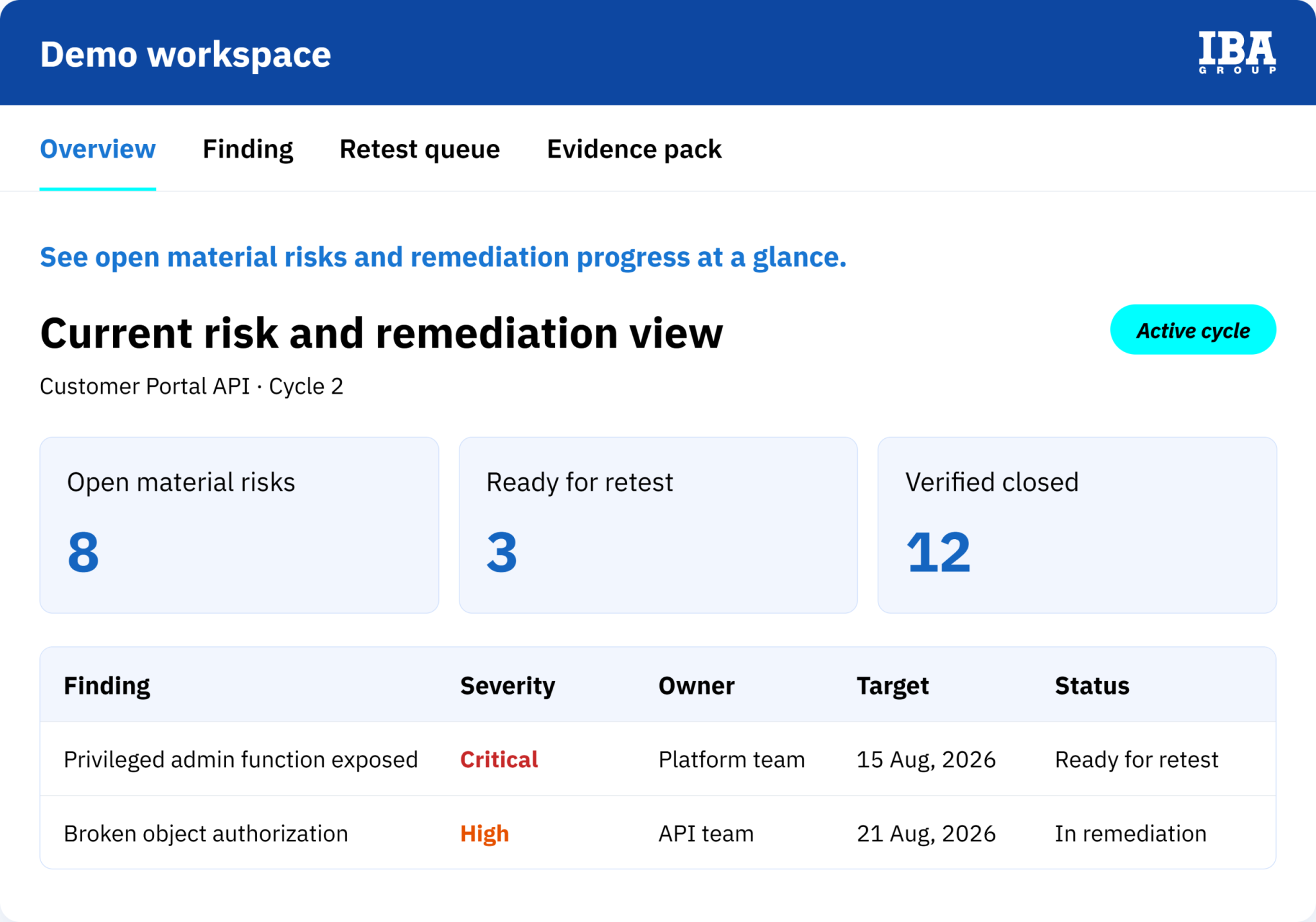
Validated findings are documented with technical detail, evidence, an owner, a target date and remediation guidance in the shared workspace.
Verify
Your team submits fix evidence. IBA retests the original attack path and records a clear pass, fail, or reopened outcome.
Prove
Executive, technical, and retest evidence is organized for audits, insurers, customer assurance, and internal governance.
Penetration Testing Services: Keep Every Material Risk Visible Until It Is Verified Closed
For continuous Penetration Testing as a Service (PTaaS), the workspace connects findings, remediation, retesting and evidence in one place. Security leaders see current exposure; engineering teams see exactly what needs to happen next
Clear accountability
Each validated finding has an owner, target date, status, remediation guidance and activity history.
Structured retesting
Fix evidence and retest requests stay linked to the original finding, with a clear verified closed, failed or reopened outcome.
Audit-ready deliverables
Beyond the final penetration testing report, deliverables can include the agreed scope, technical evidence, remediation history, retest results and tester sign-off for audits and assurance requests. These records remain available in the shared workspace so security, engineering and assurance teams can track findings through verified closure.
Use the outputs in your existing workflow
Penetration testing findings and evidence can be exported in PDF, CSV and Excel formats. Jira-ready data can be prepared; native integration requirements are confirmed during scoping.
Penetration Testing Services for Modern Enterprise Attack Surfaces
Scope is tailored to the assets, release, audit trigger and threat scenarios that matter to your organization.
Web Application Penetration Testing & API Penetration Testing
Authentication, authorization, business logic, data exposure and OWASP-aligned testing.
Mobile Application Penetration Testing
iOS and Android applications, local storage, API flows and platform-specific risks.
Network, Cloud & Infrastructure Penetration Testing
External exposure, cloud configuration, permissions, Active Directory, segmentation and privilege-escalation paths.
Source Code & Architecture Review
Targeted manual review of security-critical code paths and design assumptions.
Penetration Testing for LLM & Agentic Applications
Prompt injection, RAG and agent abuse, model and API misuse, excessive privileges, tool misuse and unsafe data flows.
IoT Penetration Testing
Device, protocol, backend and ecosystem risks across connected solutions.
Red Team Services, Social Engineering Penetration Testing & OSINT
Adversary simulation, controlled social-engineering scenarios and open-source intelligence focused on realistic attack paths.
Penetration Testing Services for European Enterprises. Led by Accountable Experts
Delivery, evidence and data handling are designed for organizations that need transparency, control and a consistent penetration testing relationship.
Named penetration testing team and EU hosting option
A consistent penetration testing team is agreed for the engagement, with controlled access to findings and evidence. EU hosting is available for the shared workspace.
Mapped to your penetration testing requirements
Evidence structures can support penetration testing compliance and assurance needs across NIS 2, DORA, ISO 27001, SOC 2 and PCI DSS, including scope, remediation and retest proof.
Human-led, AI-accelerated penetration testing
IBA experts make testing decisions and validate every published finding. AI can support penetration testing preparation, triage and reporting under human control; no autonomous testing runs against client systems.
Certified across penetration testing and offensive-security disciplines
The penetration testing team holds credentials covering web, network, wireless, mobile, red teaming, exploit development, cloud and defensive analysis.
OffSec Certified Professional (OSCP) · OffSec Experienced Penetration Tester (OSEP) · OffSec Windows User Mode Exploit Development (OSED) · Certified Red Team Operator (CRTO) · eLearnSecurity eCPTXv2 · Practical Network Penetration Tester (PNPT) · Certified Azure Red Team Professional (CARTP) · OffSec Wireless Professional (OSWP) · Hack The Box Certified Defensive Security Analyst (CDSA) · Hack The Box Certified Web Exploitation Specialist (CWES) · Web Application Penetration Tester eXtreme (eWPTXv2) · Blue Team Level 1 (BTL1) · Certified Ethical Hacker (CEH) · Cisco CCNA · Mobile Application Penetration Tester (eMAPT).
Penetration testing methodology structured around recognized standards
The methodology is selected for the target and combines a controlled engagement lifecycle with scope-specific testing guidance.
Penetration testing and evidence support assurance activities; they do not by themselves constitute certification or guarantee regulatory compliance.
Penetration Testing Engagement Models
Choose between a focused penetration test, recurring Penetration Testing as a Service (PTaaS), or a tailored managed penetration testing programme depending on your assets, testing cadence, remediation support and retest requirements. Pricing and service commitments are tailored to the agreed scope.
Focused Penetration Test
For a release, audit, major change or defined security concern.
Recurring Penetration Testing as a Service (PTaaS)
PTaaS is a recurring penetration testing model that combines scheduled testing cycles with a shared workspace for remediation, retesting and retained evidence. Continuous penetration testing means agreed assets are reassessed on a planned cadence rather than only through a single point-in-time assessment. Testing frequency is agreed based on risk, release cycles, major changes and assurance needs.
Managed Penetration Testing Programme
For regulated, multi-asset or business-critical environments requiring a customized approach.
SUCCESS STORIES
To better understand how we roll, check out the stories of those who have already successfully worked with us.






INSIGHTS
Explore expert insights on cybersecurity, penetration testing, security risks, and industry best practices.




CONTACT US
Please fill in the form to get in touch with us and share your details. Feel free to provide any additional information or specific questions you might have. Our team is committed to responding promptly and thoroughly.
Looking forward to hearing from you soon!
FAQ: Penetration Testing Services
If you’ve got any questions left unanswered, try looking here first — chances are, someone has already asked them for you, and you can get the answer you’re looking for right away!
A traditional penetration test assesses an agreed scope within a defined engagement. PTaaS adds recurring testing cycles, a shared workspace, remediation tracking, structured retesting and retained evidence. Focused one-time penetration testing remains available when recurring testing is not required.
Penetration testing can typically start within two weeks at the latest, depending on scope, written authorization, environment readiness, access requirements, and tester availability. The exact start date and testing schedule are confirmed during scoping.
The current workspace supports secure user accounts, MFA, role-based access and audit history. Enterprise SAML/OIDC SSO is assessed for strategic engagements during scoping.
IBA experts remain responsible for every testing decision and every published finding. AI may support preparation, triage, duplicate checking and report quality under controlled conditions. Autonomous penetration testing is not run against client systems.
A penetration testing retest is performed after remediation to verify that a previously identified vulnerability or attack path is no longer exploitable. The client submits fix evidence, and IBA retests the original attack path, recording the result as verified closed, failed or reopened. Retesting is needed before a material finding can be treated as independently verified closed; the number, timing and scope of retests are agreed in the statement of work.
A penetration testing report should document the agreed scope, testing approach, validated findings, technical evidence, severity and remediation guidance. IBA deliverables can also include remediation status, retest results and tester validation so security, engineering and assurance teams can track findings through verified closure.