AI Adoption for Data Analytics Team
Faster, reproducible answers to business data requests, built so the assistant writes the queries while the protected health data stays in the warehouse
Healthcare
United States
Background
The client is one of the largest health insurance providers in the United States. A dedicated data-analytics team handles data-request tickets from across the business. When a department needs numbers, such as how many new customers signed up last month, or every customer over the past year that matches a given set of conditions, it submits a ticket. Then the data-analytics team pulls the data from the corporate data warehouse and returns it, often as an Excel file.
These requests cover almost everything the business runs on, such as marketing campaign performance, where customers come from and what they cost, subscriptions and churn, payment and reimbursement patterns, and how the offering compares with competitors. The one measure that matters for business is time: from the moment the business submits a ticket to the moment it gets its data back.
Challenge
Every ticket was handled manually. An analyst read the request, worked out what it meant, wrote a SQL query against the warehouse, pulled and checked the data, formatted it and sent it back. The whole process was slow.
The team wanted to make writing and reviewing that SQL easier, but two constraints made it hard. The data is sensitive, personal health and personal information, so the future assistant could not be given direct access to the database. And the results had to be reproducible, so that running the same ticket twice produced the same query every time and the team could trust it.
Can an AI SQL Assistant work without access to sensitive data?
That was the key challenge. The assistant had to generate reliable, reproducible SQL without accessing the database or seeing any PII or PHI.
The team already had Claude and Codex subscriptions, but did not believe an AI assistant could work within these limits. They knew assistants could help write queries, but assumed that without database access it was simply not possible.
Solution Overview
We built an AI SQL assistant that helps analysts write and review SQL without accessing the database or seeing a single row of data.
Instead of working with the data itself, the assistant uses database schemas, field relationships, semantic descriptions and the team’s history of approved queries. To make the output reproducible, we built a command-line tool that reuses patterns from previously approved queries rather than generating every query from scratch.
Because the assistant cannot run queries against the database to check them, we added a static SQL analyzer. It validates each query against the required schema and approved query history, catching errors before an analyst runs it.
The client already had Claude and Codex subscriptions, so we built on the tools they already used rather than introducing a new AI stack.
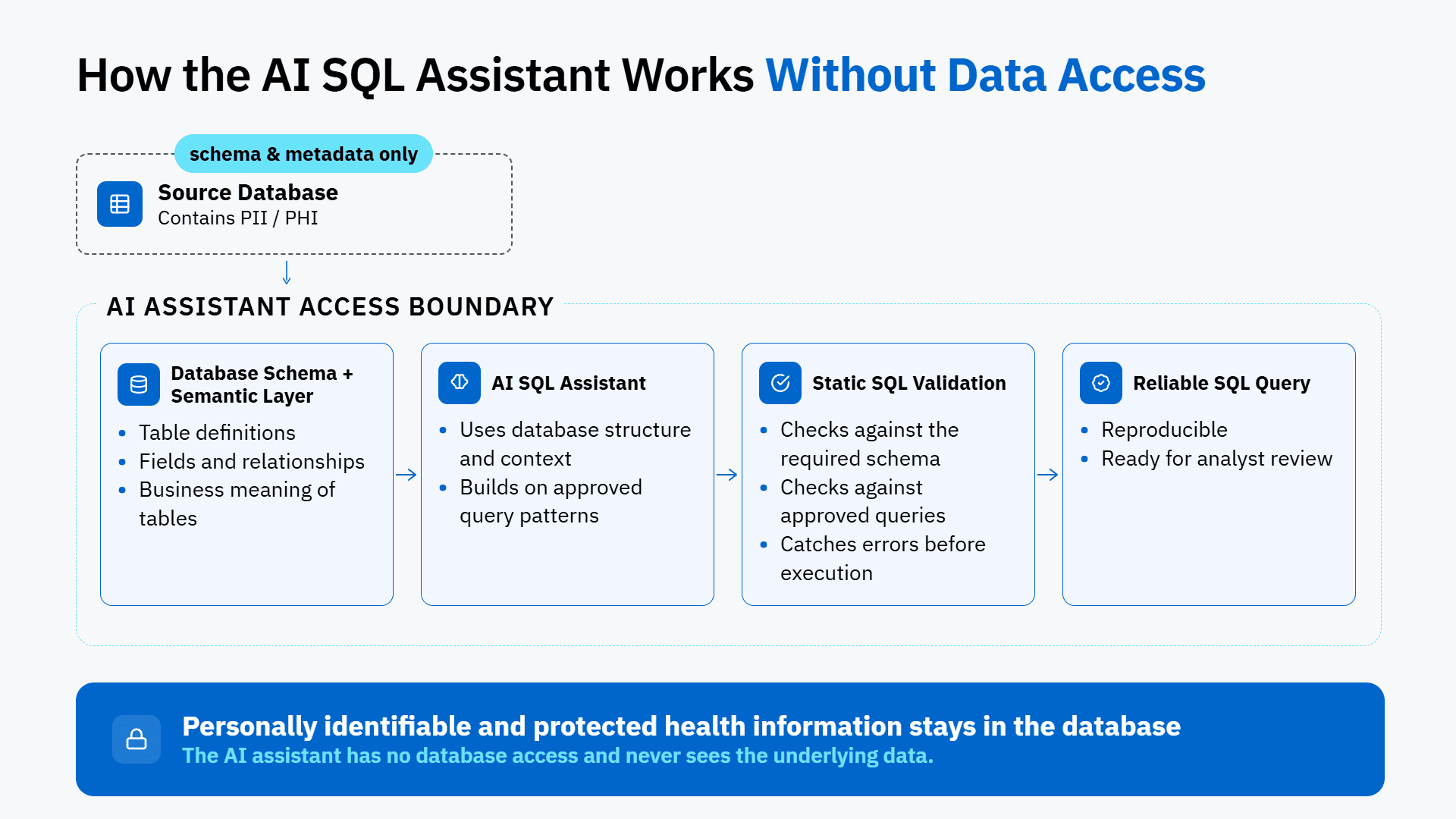
The key design principle is that the assistant never accesses the database itself. Personally identifiable and protected health information (PII and PHI) remains inside the source system, while the assistant receives only the schema, metadata and semantic context it needs to understand the database structure and generate SQL.
This separation allows the team to use AI for SQL generation and validation without exposing the underlying sensitive data
Results
For the business, the assistant delivers a faster turnaround on data requests from the same team. What the client gained:
- Faster data delivery. Tickets that took about 12 hours now take about 7, over 40% faster, so the same team answers more of the business’s questions each day and decisions no longer wait on data.
- Consistent, auditable results. The same request always produces the same query and the same numbers, so reports stay consistent over time and every result can be checked and traced.
- Sensitive data kept safe. The assistant works entirely without database access, so PII and PHI never reach it, and the business takes on no new privacy or compliance exposure by using it.
- More analysis, less manual work. The team now spends its time verifying results and answering harder questions instead of writing every query by hand, putting skilled people on higher-value work.
After the most senior analysts tested and approved the AI SQL assistant, it is now being rolled out to the whole team.
About IBA Group
IBA Group has been delivering custom projects since 1993 for clients in over 50 countries. Our AI Tech Consulting practice helps enterprises adopt and scale AI across complex business and IT environments. We design, audit and improve AI solutions with a focus on production readiness, accuracy, security, governance, integration and measurable business value.
Contact Us
Please feel free to include any information about your business you think we should know