SAP-Based Automated Store Replenishment for a Multi-Store Retailer
Bringing SAP’s Strategic Retail Planning Capability into Live Operation on an Existing SAP CAR Platform
Retail
Eastern Europe
Background
The client is a European food-first retailer with an unusually integrated value chain: it manufactures a large share of what it sells, moves it through its own distribution centres, and sells it through a multi-format, multi-banner network of several hundred stores, from hypermarkets to neighbourhood convenience shops. That profile puts fresh and perishable goods at the centre of the business: dairy, bakery, chilled meat and fish, fruit and vegetables, where availability, shelf life and spoilage are decided every single day, at every single store.
Challenge
The ordering process did not match the sophistication of the operation. Replenishment quantities were worked out manually in spreadsheets and keyed into SAP by hand. An earlier initiative to use standard MRP had been abandoned as unsatisfactory, and the gap had been bridged with a custom report for mass order creation.
The result was a process that was labour-intensive, slow, difficult to scale across the estate, and entirely dependent on the individual expertise of the buyers, with no systematic way to weigh service level against stock, shelf capacity and the cost of spoilage.
The client came to us with a clearly defined need to automate the creation of replenishment orders, using an innovative, flexible solution aligned with SAP retail best practice.
Solution Overview
We started with an assessment of the viable options. Three met the client’s requirements:
Following the assessment, our SAP expert team recommended SAP RP as it solved the stated problem, fit the existing architecture, protected the client’s roadmap by aligning with the direction SAP is actively investing in, and did so without a new licence line. Rather than commit the client to an estate-wide programme on the strength of a slide deck, we proposed to run a pilot on 20 stores and roughly 5,000 SKUs, drawn from every store format, to demonstrate the functionality and the numbers in live operation, with rollout to follow on the client’s terms once they were convinced.
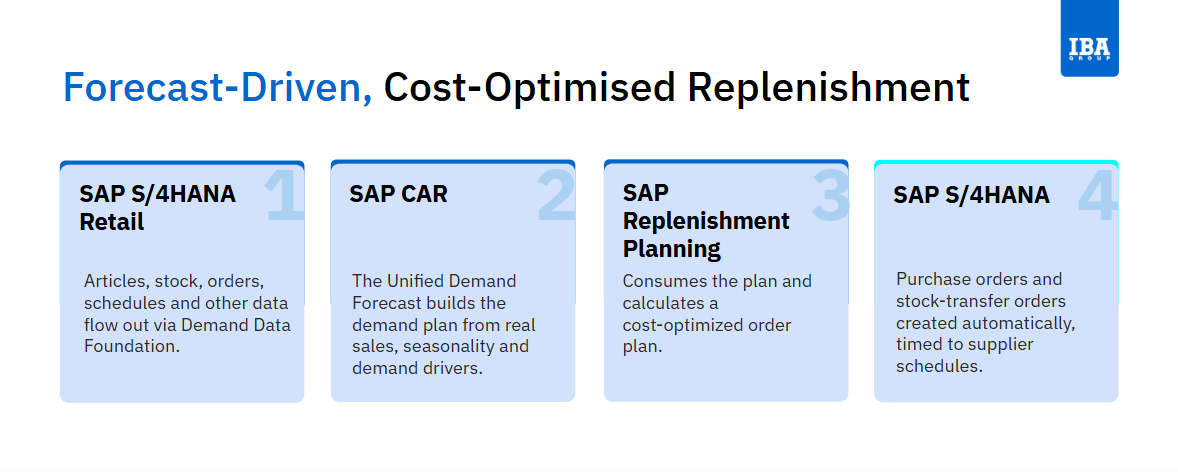
The solution links the two systems into a single daily cycle.
- Feeding data into SAP CAR. Master and transactional data (articles, stock, orders, schedules, etc.) move from SAP S/4HANA Retail into SAP CAR through Demand Data Foundation (DDF), while sales data is already stored in SAP CAR.
- Forecasting demand. The Unified Demand Forecast builds a demand model and forecast that accounts for actual sales, seasonality and demand-influencing factors.
- Planning orders. SAP Replenishment Planning consumes that forecast and calculates order plan items.
- Creating orders in SAP S/4HANA. The approved plan is passed back to SAP S/4HANA, where purchase orders and stock-transfer orders are created automatically, with delivery timing aligned to supplier schedules. At the client’s request, promotions remain managed in SAP S/4HANA and are replicated into SAP CAR so their demand effect is reflected in the forecast — a deliberate decision to leave a working process untouched.
What makes SAP RP more than an automation script is its cost-optimized ordering logic. For each product at each location it proposes the order quantity that leads to the lowest expected total cost, explicitly trading off lost sales, shelf-capacity limits, minimum stock and, critically for this client, expected spoilage driven by product shelf life. Our team configured SAP RP around the retailer’s intraday replenishment, a flexible planning horizon, real-time stock, exception-based alerts that direct planners only to what needs attention, and simulation that lets planners test parameter changes against replenishment KPIs before committing them.
We used that flexibility to implement differentiated replenishment strategies tuned to the nature of the product and the format of the store, a distinction that is decisive for a fresh-led retailer:
- Fresh / ultra-fresh across all formats: very short order cycles, minimal stock, zero-out-of-stock priority for key value items (milk, bread), shelf life factored directly into the requirement.
- Ambient long-shelf-life goods in large formats: less frequent, larger, pack- and pallet-efficient orders that exploit storage capacity and consolidate DC supply.
- Ambient long-shelf-life goods in small formats: frequent small-batch, just-in-time ordering constrained by limited shelf space.
- Frozen across all formats: freezer-capacity ceilings and seasonal demand profiles built into the order proposal.
Data as the Foundation, and Engineering an Early-Adopter Solution
The forecast and the order calculation stand on the master data and sales history migrated for the in-scope stores: roughly 150,000 material/location relationship records were revised and migrated, and about 18 months of sales history (the raw material UDF needs to model demand) was loaded in staged, quarter-by-quarter passes to move the volume reliably. This foundation is what allowed the forecast to reach the accuracy the client recognised.
We deployed SAP RP as an early adopter on the client’s established landscape (SAP S/4HANA 2020 and SAP CAR 5.0). Being at the frontier of a fast-moving solution meant meeting and clearing genuine technical ground, resolved through a disciplined combination of targeted SAP Notes and precisely scoped customizations, so that the standard solution ran cleanly in the client’s specific environment.
Our SAP team also made a pragmatic go-live choice: because only the productive system held the fresh, complete data the calculation depends on, we started live on a single store in production, fine-tuned the configuration against real results, and then scaled the proven setup across the remaining stores. The effect was a low-risk, evidence-based rollout in which every expansion built on a configuration already validated on real operations.
Results
The pilot runs in production across 20 stores and around 5,000 SKUs today, and the replenishment cycle is fully automated end to end:
- Orders are ready before the working day begins. By the time buyers arrive, external purchase orders and inter-site stock-transfer orders have already been generated from the latest sales, stock, open-order and delivery-schedule data. The buyers’ role has shifted from calculation and data entry to review and release.
- Accuracy matched the experts. The client’s own assessment is that SAP RP’s calculated quantities are as accurate as their previous manual calculations, the benchmark that earned their confidence, but produced systematically and without manual effort.
- Hours became minutes. Order preparation that previously consumed hours of daily spreadsheet work now completes as an unattended batch job in minutes, freeing skilled staff for exception handling and higher-value work.
- A capability built for fresh. Shelf-life-aware, cost-optimized ordering gives the client, for the first time, a systematic way to balance availability against spoilage and shelf capacity, the trade-off at the heart of a fresh-led business, with headroom to extend into intraday replenishment and further formats.
For any enterprise weighing a move into SAP’s newer, strategically positioned solutions, this engagement shows what a credible partner brings:
- The ability to bring SAP’s strategic products into real production: we not only configure mature modules, but production-harden a solution on a real client landscape and make it deliver.
- A bias toward maximising the SAP investment the client already owns: our team delivered automated store replenishment on the existing SAP CAR platform, with no new system and no additional licence.
- Data treated as part of the deliverable, because a forecast-driven capability is only as good as the master data and history beneath it.
- A pilot-first, evidence-based path from proof of value to enterprise rollout that keeps risk low and puts the decision to scale firmly in the client’s hands.
About IBA Group
IBA Group is a long-standing SAP SE partner. We’ve delivered custom SAP projects since 1996. Our team includes more than 250 certified SAP specialists with deep experience across a wide range of SAP projects for clients in over 50 countries.
Considering an SAP Replenishment solution for your business?
Contact Us
Please feel free to include any information about your business you think we should know (e.g., by how much you’d like to reduce your current data hosting expenses, or which cloud provider you’d prefer and why).