GenAI Tech Consulting for Intelligent Document Processing in Logistics
We audited the client's AI document processing, found why it broke at scale, and led the architecture that took it to production
Transport & Logistics
Europe
Background
The client is a logistics and transportation company that receives a large volume of inbound documents, such as bills of lading and related paperwork, from customers and partners across borders. Every document has to be read and the right information taken out of it, and both the volume and the variety make that slow and costly to do by hand.
To automate the work, the client’s own team built a Generative AI-based Intelligent Document Processing (IDP) proof of concept to extract the required information from each document. The team were strong engineers with years of classic machine learning (ML) and natural language processing (NLP) behind them, but generative AI was new ground, and this was effectively their first GenAI project.
Why does GenAI document processing require a different approach from classic ML?
Large language models are not deterministic. Extraction quality depends not only on the model, but also on how it is prompted, constrained and checked – especially when the system has to handle many document formats at production scale.
On a small, chosen set of documents, the system worked well.
Challenge
The trouble with the PoC appeared at production scale. It had performed well on a small, controlled set of documents, but the real production environment was far more varied and less predictable.
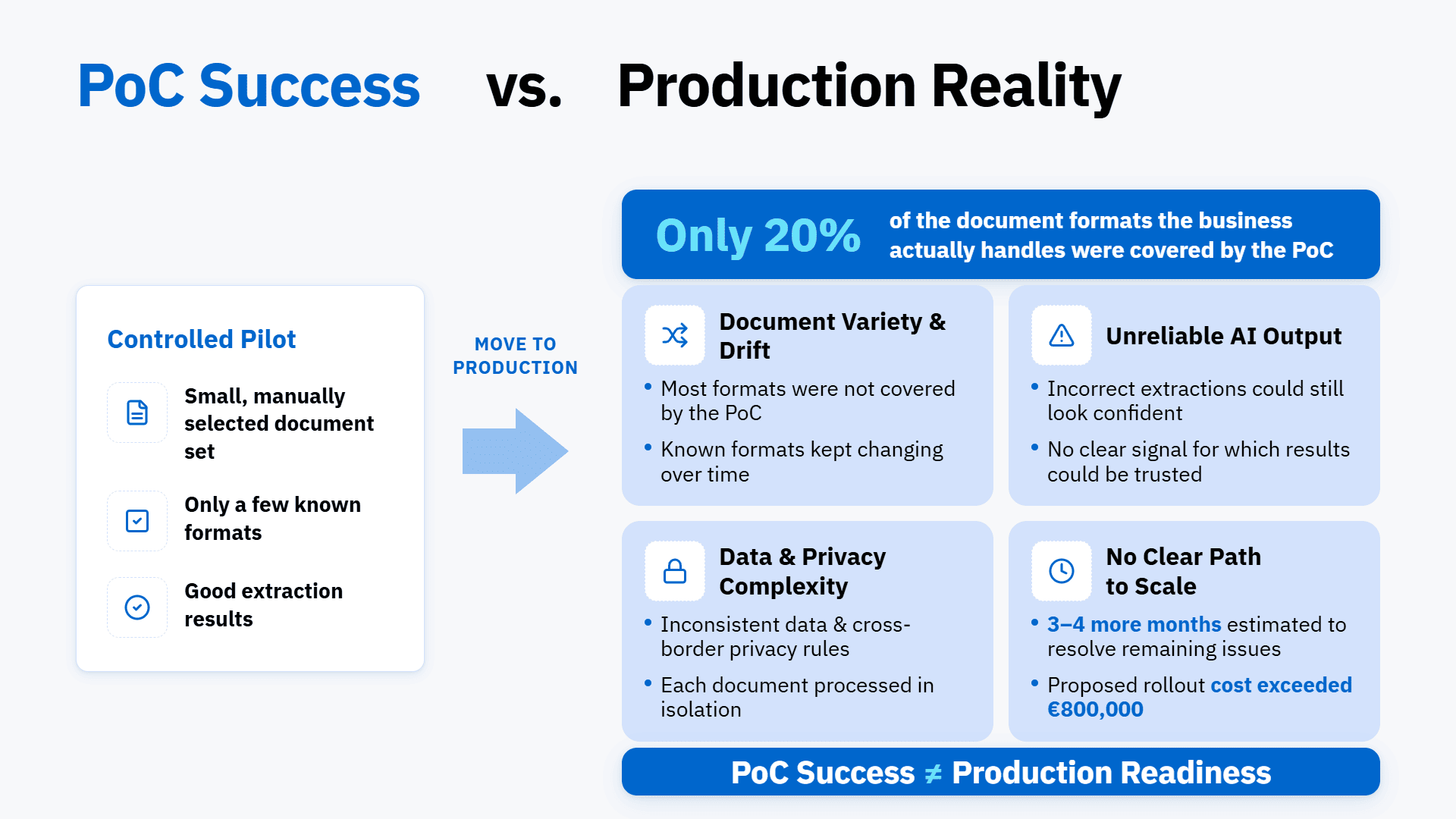
Generative AI was still the right technology for Intelligent Document Processing. The documents contained hundreds of data points, many embedded in free text, which made rule-based or classic ML extraction difficult to scale. At the same time, the incoming data was inconsistent and there were no clear rules for how it should be handled. The problem was not the choice of GenAI itself, but how to make the system reliable across the full document set.
The CIOs were not convinced it was worth the money. A full rollout, following proposed strategy from their team, would cost more than €800,000, and they could not tell whether it would pay off, so they held back from approving it.
Solution Overview
We provided GenAI Tech Consulting to audit the client’s IDP system, identify why it failed at scale, and set the architecture that would take it to production. The client already had a capable team, so our job was to find why the system failed at scale and set the technical direction to fix it.
We began with a two-week audit of the whole path the data takes, from the moment a document arrives to the point its data is used. The audit mapped the data inconsistencies across the client’s depots, showed exactly where accuracy dropped in the process, and identified the gaps in how the GenAI outputs would connect to the rest of the business.
Over the next six weeks, we turned the audit findings into a practical improvement plan. This is where our GenAI Tech Consulting expertise complemented the team’s strong ML and NLP background:
We set out governance guidelines for the sensitive, cross-border data. And we provided an integration strategy for connecting the GenAI outputs to the client’s ERP and TMS systems, so the extracted data would reach the systems where the business actually uses it.
The build stayed with the client’s team, and our architect led the technical direction throughout, shaping the core architectural principles and keeping oversight as the team moved the system into production.
Results
Our audit showed the CIOs what was actually wrong and what fixing it would cost. Our architecture work then got the system into production much faster and cheaper than the team expected.
- Accuracy high enough to trust. Extraction accuracy reached 90% before rollout, reliable across the full document set, so the business can rely on the extracted data instead of re-checking it by hand.
- In production in weeks, not months. The system reached production in 10 weeks instead of the six months first expected, and once live it cut end-to-end processing time by 65%, so the same team clears far more documents and the automation starts paying off sooner.
- Lower cost, and a clear case to commit. Rollout costs came down 25%, below the team’s own fix budget, which gave the CIOs the numbers they needed to approve it.
- Built to grow. The system can already handle five times as many documents as it does today, so as the volume grows the business keeps using the same system instead of building a new one.
- A solution their own team owns. The client’s engineers did the build with our architect guiding the technical direction, so the team fully understands the system and can run and improve it themselves, without depending on an outside vendor.
About IBA Group
IBA Group has been delivering custom projects since 1993 for clients in over 50 countries. Our AI Tech Consulting practice helps enterprises adopt and scale AI across complex business and IT environments. We design, audit and improve AI solutions with a focus on production readiness, accuracy, security, governance, integration and measurable business value.
Contact Us
Please feel free to include any information about your business you think we should know