SAP in October 2026: Agents Get Dates and Prices, While Adoption Lags Behind
October was SAP’s busiest month since Sapphire. SAP Connect in Las Vegas, SAP TechEd in Berlin, a feature pack for SAP S/4HANA 2025, the monthly Security Patch Day and the third-quarter results all fell within four weeks. Most of the headlines were about agents, and here SAP finally answered several practical questions: when individual assistants ship, what an agent action costs and which controls surround agents in production. What October did not show is broad use of these capabilities in production. The German-speaking user group DSAG, meeting in Cologne in the same week as SAP Connect, stated plainly that reliable customer experience with Joule Work does not exist yet.
The month in brief. Joule Work and most Joule assistants entered phased general availability. SAP extended the free Joule Studio runtime through December for select customers and announced an Enterprise AI Gateway. S/4HANA 2025 FPS02 added IFRS 18 support for on-premise and private cloud systems. The Patch Day closed four critical vulnerabilities, two of which turn ordinary business permissions into an attack path. Quarterly revenue passed €10 billion for the first time, while software support revenue continued to fall.
This review follows our September analysis, and several items left open a month ago now have a status. IBA Group has been an SAP partner since 1996, and we read the news as an implementation and support partner whose clients run ECC, S/4HANA on-premise and the cloud editions side by side.
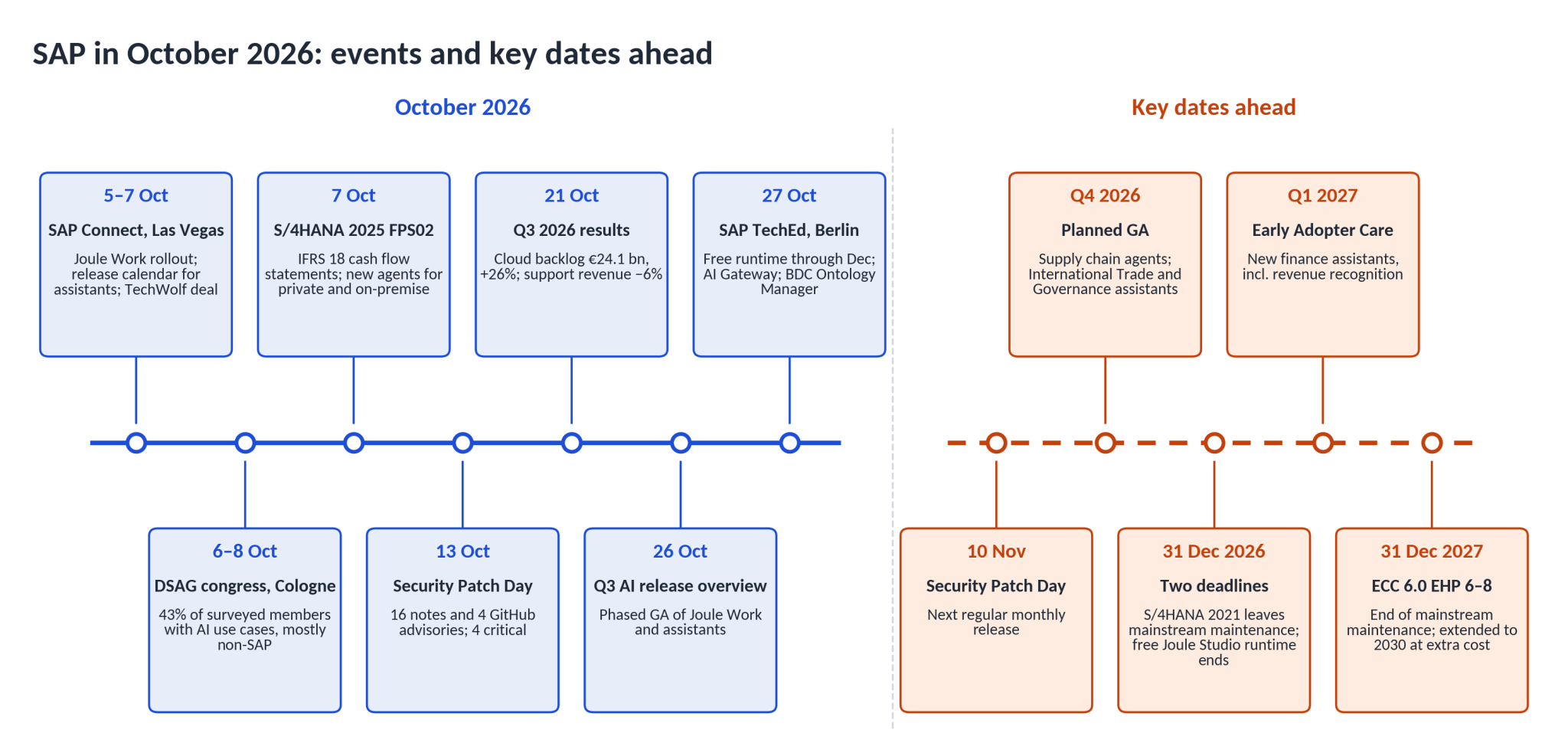
SAP events in October 2026 and the key dates ahead
Source: IBA Group. AI-assisted visualization
SAP Connect 2026: Joule Work and a Timetable for Agents
At SAP Connect on 5–7 October, SAP presented Joule Work as the main interface to its assistants and agents. A user states a goal in natural language, Joule picks an assistant, and the assistant coordinates specialised agents within existing authorisations and audit trails. ERP Today reports that SAP runs Joule Work internally for 110,000 employees and claims 20% productivity gains in finance, HR and procurement. The external rollout has only just started, and the two companies with measured results that SAP named, Nestlé and Reinhausen, are large S/4HANA users.
The release calendar was more informative than the keynote. SAP’s innovation guide separates what is available now from what arrives in Q4 2026 and what reaches only Early Adopter Care in Q1 2027. Several new finance assistants, including revenue recognition and disclosure, are in the last group. A business case approved this autumn for one of them should not count on production use before the second half of 2027, once testing and rollout are added.
SAP followed on 26 October with an overview of the quarter’s AI releases. The Q3 AI release overview says that 45,000 cloud customers use SAP’s AI solutions and that general availability of most assistants is underway in phases. The figure needs context. It counts any use of SAP AI, including features that now come in the base subscription, and says nothing about how many companies run agents in production. The same document resolves a question from September. The Financial Closing Orchestration Agent is now part of the Financial Closing Assistant together with six other agents, including the Accounting Accruals Agent and the Receivables and Payables Clearing Agent. Phased availability means the status differs by tenant and region.
Status of selected capabilities as of 28 October 2026:
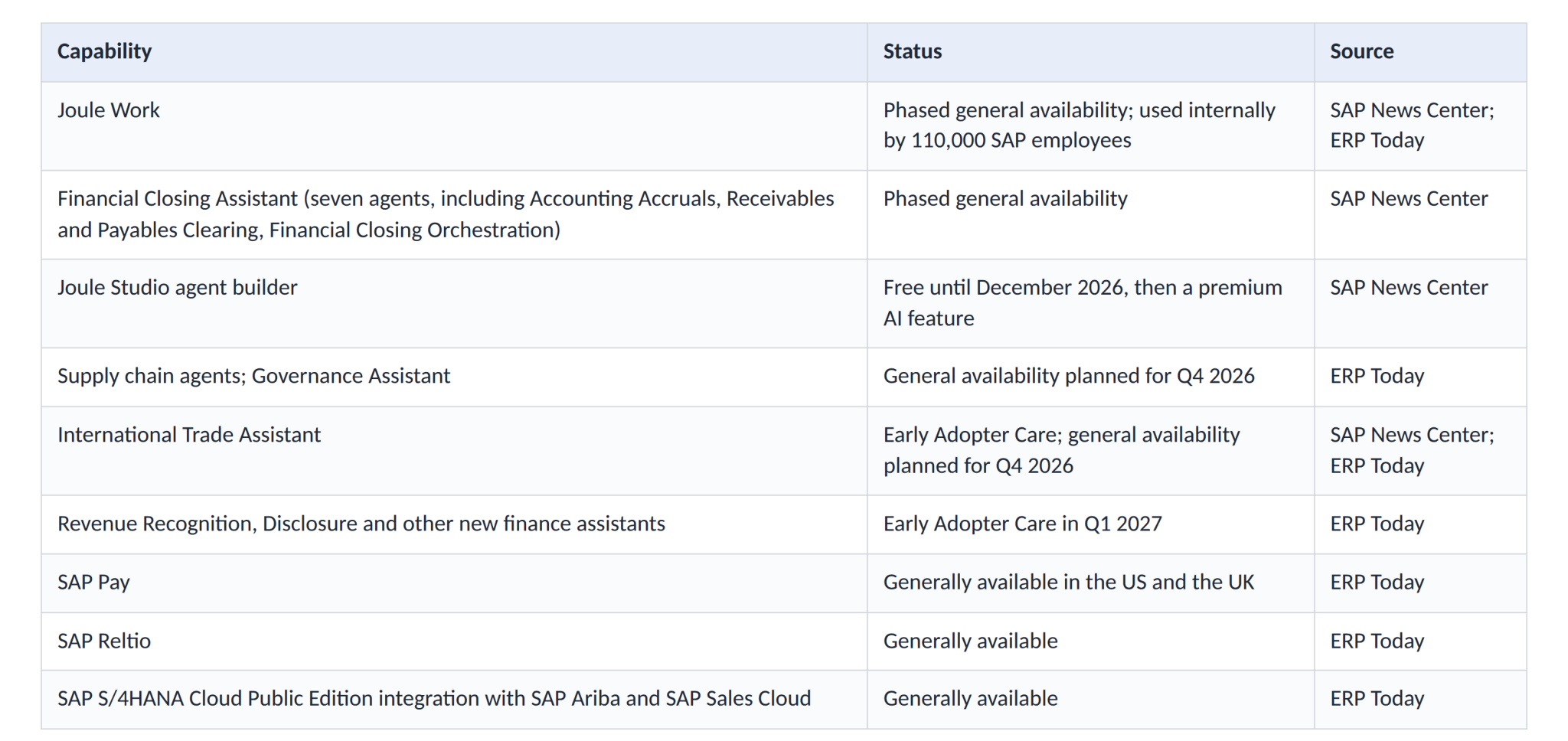 Rollout status of SAP assistants and agents announced or updated in October 2026
Source: IBA Group. Compiled from the sources in the Source column
The user side looks less advanced. According to the DSAG investment report cited at its congress on 6–8 October, 43% of member companies surveyed in January had implemented AI use cases, and most of them used non-SAP solutions. DSAG sees a gap between SAP’s vision, the solutions actually available and the benefit companies get, and asks SAP to explain more clearly which Joule offerings exist today and under what conditions. Our own project experience is similar. Agents are being piloted, mostly in finance and mostly by companies with a stable S/4HANA core, while the bulk of SAP work still consists of migrations, upgrades and support.
SAP S/4HANA On-Premise, Private Edition and ECC: Where Most Budgets Still Go
For the installed base, the most relevant release of the month was SAP Cloud ERP Private 2025 FPS02, delivered as the same feature pack for S/4HANA 2025 on-premise. Besides new agents and AI-assisted functions, it adds support for IFRS 18 indirect-method cash flow statements, Germany’s AUSWIB1M foreign trade reporting and Canadian First Nations tax determination, along with industry functions for asset-intensive companies, upstream oil and gas, defence and retail. IFRS 18 replaces IAS 1 from 1 January 2027, so finance teams on S/4HANA 2025 should test the new statements this winter rather than during the first close of next year.
Two maintenance dates matter more than any feature. S/4HANA 2021 leaves mainstream maintenance at the end of 2026 under SAP’s five-year rule for releases up to 2022; systems on that release (S4CORE 106) have two months before they move to customer-specific maintenance. From release 2023 onwards, mainstream maintenance lasts seven years, so an upgrade to 2023 or 2025 buys a long period of stability. ECC 6.0 with enhancement packages 6 to 8 leaves mainstream maintenance on 31 December 2027, with paid extended maintenance until 2030.
The DSAG figures show how the market is actually moving. Among surveyed members, 56% run S/4HANA on-premise and 42% plan high or medium investment in it for 2026, while the public cloud preferred by SAP plays a minor role in the DACH region. DSAG welcomes SAP’s investment in migration and modernisation assistants for ECC conversions and S/4HANA upgrades but notes that there are no customer reports yet on their effect. In practice, a conversion still depends on custom code analysis, data cleansing and regression testing, and on the experience of the team doing it. IBA Group’s S/4HANA transition practice and the recovery of a stalled programme at Georgian Railway both point the same way: schedule risk sits in data and integrations, not in the tooling.
SAP S/4HANA Cloud Public Edition: Smaller Features With Control Implications
Public Edition received several AI features listed as generally available in the Q3 overview: summaries of Generic Drilldown reports, document extraction for business partner master data, posting proposals for incoming bills of exchange, analytics for aging work in process, and AI support for EHS compliance management. Integration with SAP Ariba and SAP Sales Cloud is also listed as generally available.
Two of these features affect internal controls. Business partner extraction fills in names, addresses, tax numbers and bank account details from uploaded purchase orders, quotations and invoices. A changed bank account on a supplier record is a classic fraud vector, so a change prompted by a document should go through the same four-eyes approval as a manual one. Report summaries put generated text into management reporting; someone has to own its accuracy before it reaches a board pack.
As in September, the release arrives on a fixed schedule whether or not the organisation is ready. Deciding which roles see which AI functions and updating internal control documentation belongs in the regular release readiness check for SAP S/4HANA Cloud ERP.
Agent Costs and Governance: Free Runtime Extended, Controls Announced
SAP’s AI pricing page sets the price of SAP-delivered agents at 0.02 AI Units per agent action in 2026 and states that an idle agent consumes nothing. An action is a single step, such as a service call or a workflow trigger, so one business task involves several actions. At this rate, 2,000 period-end tasks a month at eight actions each would consume 320 AI Units a month. The number of actions per task depends on how the agent reasons through the case and can only be measured in a pilot. Unused AI Units expire after 12 months, which penalises over-buying. For budgeting, the design of the agent therefore matters as much as the transaction volume.
For custom agents the terms changed again. In September we cited SAP’s statement that the Joule Studio runtime would be free until the end of October. SAP revised this at TechEd in Berlin. According to the press release of 27 October, select customers can deploy and run custom agents on the SAP-managed runtime free of charge through December 2026, with design-time tools free under fair-use limits. The Q3 overview adds that the agent builder becomes a premium AI feature after December. The promotion applies to select customers only, so eligibility has to be confirmed contract by contract.
TechEd also added control points around the business authorisation check described in our September review. Joule Studio gained observability for agent behaviour, model usage and spend. The new SAP Enterprise AI Gateway is meant to centralise authentication, policy enforcement, routing, monitoring, usage tracking and auditing of AI traffic. An AI Governance Assistant is intended to support EU AI Act compliance, and third-party agents will call Joule Agents through a governed gateway. SAP has not published prices for the AI Gateway, and the press release describes it in the future tense.
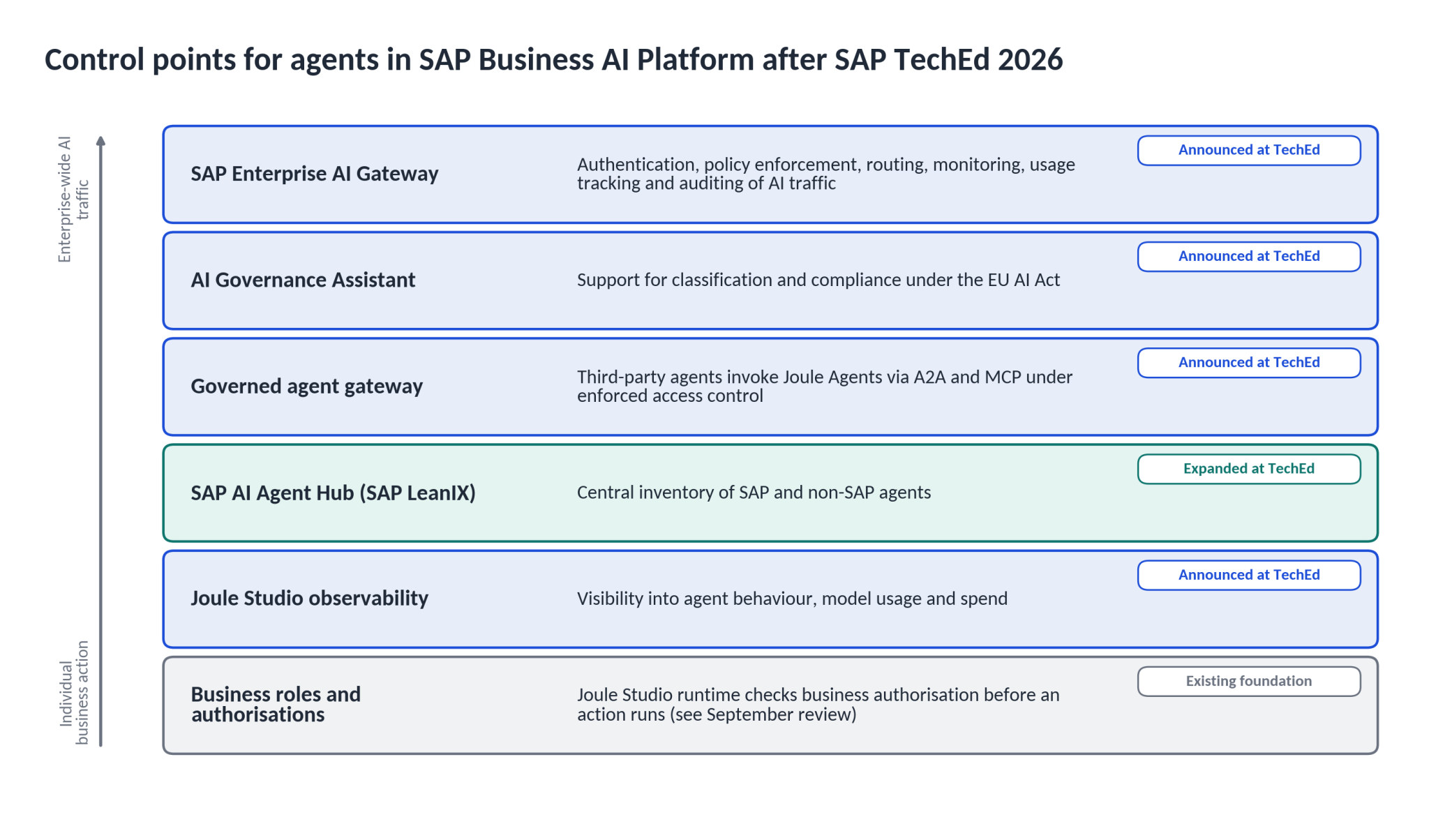 Control points for agents in SAP Business AI Platform after SAP TechEd 2026
Source: IBA Group. AI-assisted visualization based on the SAP News Center press release of 27 October 2026. SAP and Joule are trademarks of SAP SE
Most of these controls are announcements, and their value will become clear only after the first production rollouts. Companies already piloting agents should have an agent inventory, spend reporting and reviewed roles in place before the free period ends. Custom agents on SAP BTP need the same discipline as any other development, with versioning, testing and controlled transport, which is how IBA Group runs SAP BTP development and integration.
Key Takeaway.
An agent pilot is worth starting only where the process, the data and the roles are already in order; otherwise it measures the state of the core rather than the agent.
SAP Business Data Cloud and SAP BTP: Context Layer and Sovereign AI
TechEd’s data announcements aim to give agents business context. SAP Business Data Cloud will receive an Ontology Manager for describing how data from different systems relates. Through Dremio, BDC adds native support for Apache Iceberg and Apache Polaris and a federated query engine that reads data without copying it. The Databricks partnership grows into SAP Databricks within BDC, and SAP Reltio brings multidomain master data management into BDC.
For analytics teams, a less visible document may matter more. SAP published an updated statement of direction for SAP BusinessObjects BI and SAP Data Services. Both remain supported, and existing deployments can stay on-premise or in managed cloud. SAP recommends BDC for new cloud-native scenarios and plans to sunset Lumira Designer with BI 2029. Many SAP landscapes will therefore run BusinessObjects and BDC in parallel for years.
Reltio next to SAP MDG raises a design question for 2027: which master data domains stay governed close to the ERP and which move to a multidomain hub. IBA Group works with SAP MDG and data quality management, and in our experience the decision depends mostly on the number of non-SAP sources. SAP also introduced SAP-RPT-2.0, which adds anomaly detection to classification and regression, and SAP-RPT-TS for forecasting in SAP Integrated Business Planning. These models work only as well as the source data, which is where BDC implementation and data and AI work overlap.
On sovereignty, the Q3 overview lists Mistral’s enterprise AI platform as generally available on SAP Business AI Platform, hosted on SAP Cloud Infrastructure within a trusted region, and a fully sovereign version on SAP Sovereign Cloud is planned for early 2027. For European clients, sovereignty checks continue to run alongside NIS2 and DORA obligations, covered in IBA Group’s NIS2 and DORA testing practice.
SAP Security Patch Day October 2026: When Business Roles Become Attack Paths
The October Security Patch Day on 13 October brought 16 new security notes and four GitHub security advisories, four of them critical. None of the three critical SAP Notes can be exploited anonymously. Each requires an account, from a business user with access to rule management to an MII administrator.
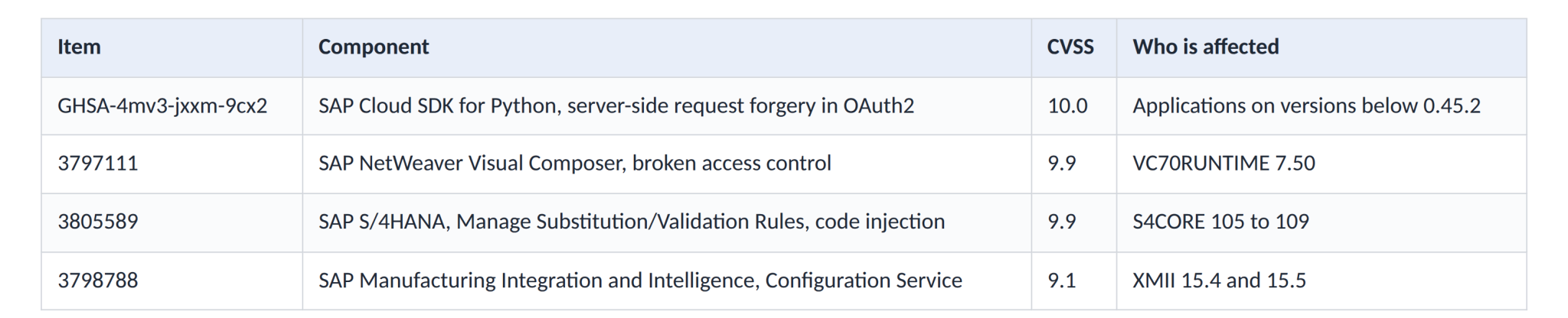
Critical items of the SAP Security Patch Day, October 2026
Source: SAP Support, Security Patch Day, October 2026
ERP teams should look at note 3805589 first, as it touches the finance core directly. The code injection sits in the substitution and validation rules functionality and can lead to execution of ABAP code by an authenticated user; it affects S/4HANA on-premise and Private Edition from release 2020 onwards, while SAP patches Public Edition itself. Note 3797111 lets a low-privileged portal user reach operations on connected remote systems, so the damage depends on the permissions of the backend connection. Note 3765424, rated high, allows an unauthenticated request to crash the ICM or Web Dispatcher where HTTP/2 is enabled, the default since release 7.73. SecurityBridge points out that workarounds exist for the S/4HANA and Visual Composer issues, but not for MII, where the number of administrators should be kept to a minimum until the patch is in.
The pattern links to our September discussion of agents. Agents act through the same business roles as employees, and October shows that a role with access to configuration-like apps is already a technical risk. Role reviews should cover access to applications that interpret user input as logic, not only segregation of duties. Under an SAP application management contract this is routine change work; a wider assessment belongs with IT security services.
SAP Q3 2026 Results, Acquisitions and Corporate Signals
SAP published third-quarter results on 21 October. Current cloud backlog reached €24.1 billion, up 26% at constant currencies, cloud revenue grew 25% to €6.67 billion and total revenue exceeded €10 billion for the first time, according to the quarterly statement. Cloud ERP Suite revenue grew 28%. SAP now expects 2026 cloud revenue towards the upper end of its €25.8–26.2 billion range. The statement also notes that cloud growth was helped by a multi-quarter revenue catch-up from customers returning from financial distress, and that cloud gross margin fell 0.7 percentage points to 73.9%.
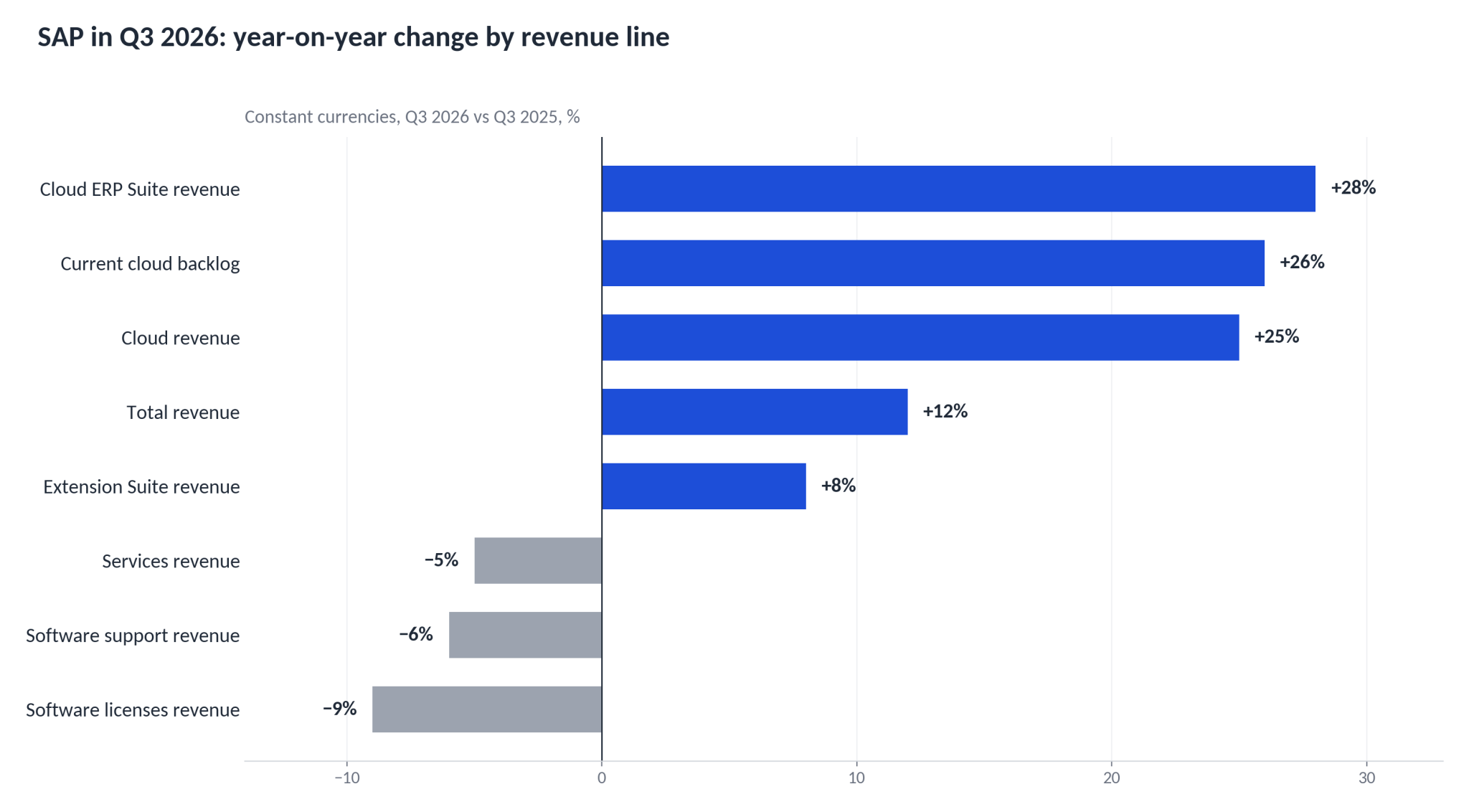
SAP in Q3 2026: year-on-year change by revenue line at constant currencies
Source: IBA Group. AI-assisted visualization based on SAP’s Q3 2026 quarterly statement (link above)
The support line tells the on-premise story. Software support revenue fell 6% at constant currencies, and SAP expects the decline to accelerate as companies move to the cloud. Combined with the EU commitments on on-premise support covered in September, this gives ECC and S/4HANA on-premise users more room in renewal negotiations, especially those who plan to use extended maintenance until 2030.
The statement also confirms SAP’s agreement to acquire TechWolf, which maps employees’ work and skills. It is the fourth AI and data deal of 2026 after Reltio, Dremio and Prior Labs, which together added €49 million to Q3 revenue. TechWolf’s data sits in the domain of HR systems such as SAP SuccessFactors, and like the earlier deals it buys context for agents rather than new transactional functions. SAP lists AstraZeneca, Infineon Technologies and Nagel Group Logistics among new RISE with SAP contracts and Bertelsmann, HUGO BOSS and Mondelez among Q3 go-lives.
SAP Updates: What to Do in November 2026
The list is ordered by urgency. Most items fit into an existing support contract.
- Security (ABAP, portal and MII systems, BTP applications). Apply the workarounds for notes 3805589 and 3797111 if the patches cannot be installed before the next maintenance window. Keep MII administrator accounts to a minimum, check HTTP/2 exposure of ICM and Web Dispatcher, and review access to rule management apps. Update SAP Cloud SDK for Python to version 0.45.2 or later.
- S/4HANA 2021 systems. Confirm the upgrade target and date. If the upgrade cannot happen before 31 December, agree with SAP on the support terms that will apply in the meantime.
- ECC 6.0 users. Decide by the end of 2027 whether to take extended maintenance, and use the declining support revenue trend and the EU commitments in renewal talks. Align the renewal with the conversion plan instead of negotiating them separately.
- S/4HANA 2025 users. Test the IFRS 18 cash flow statements from FPS02 before year-end.
- Public Edition users. Check which Financial Closing Assistant agents are active in the tenant, decide by role which AI features are visible, and keep four-eyes approval for bank details taken from documents.
- Agent pilots. Confirm eligibility for the free runtime through December, measure actions per task, and set up an agent inventory and spend reporting before January. Start with one process where data quality is already known.
- Analytics teams. Plan the replacement of Lumira Designer applications against the BI 2029 date.
These steps are ordinary work for an experienced SAP delivery and support team and rarely need a separate project.