What Makes a Difference in Effective AI Adoption? Nothing Other Than Data Quality. Part 2.
Table of Contents
Key Data Quality Capabilities for AI Readiness
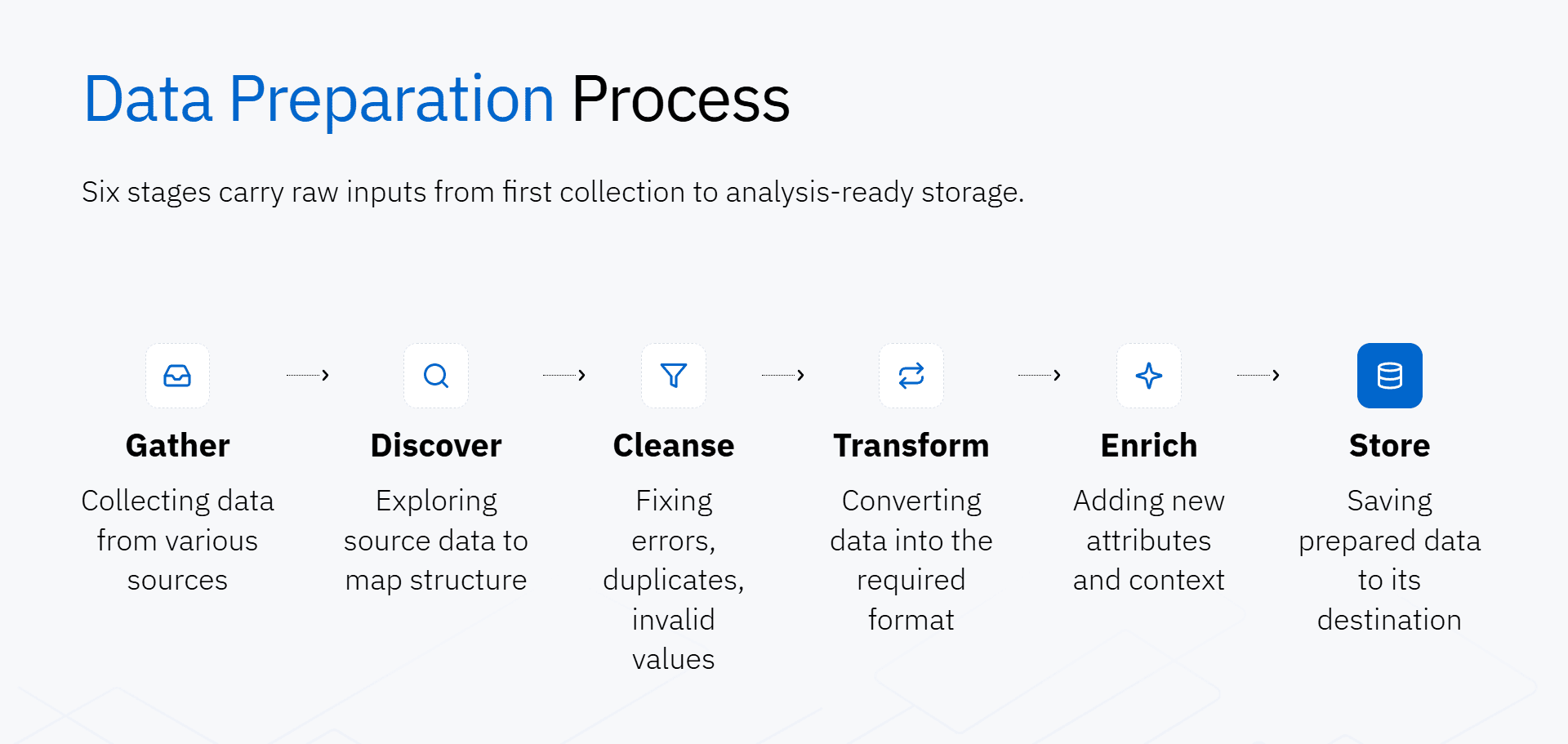
So, before jumping to AI deployment, we need to squeeze information pouring from various sources through tools that can upgrade data quality for AI systems and get it nicely piled up in a reliable data platform, be it a tried-and-true warehouse or a newfangled lakehouse. You are free to choose from numerous data quality automation solutions available out there, but make sure they are smart enough to do the following:
- Data profiling. For the tool to be able to recognize and fix issues, it should first explore datasets and collect their characteristics.
- Data elimination/reduction. Duplicate and irrelevant pieces of information need to be removed for more accurate results.
- Data standardization/normalization. The tool should use both these methods of bringing data to a unified format.
- Data harmonization. Information pulled from multiple sources has to be transformed into a cohesive dataset.
- Data cleansing/transformation. The tool should be able to either remove corrupt records or turn them into correct values by fixing inaccuracies.
Let’s explore several examples showing why data preparation and quality management remain a significant part of machine learning projects:
- Data reduction. Say, you need to train an ML model to make customer purchase predictions. You will need records on each customer’s browsing and purchasing behavior, such as the number of website visits and purchases made over a certain period, the total amount of items viewed and money spent during this time, etc. However, some information in the dataset, for example, customer favorite brands, can be irrelevant to your purpose and should be removed. Strongly correlated records like the number of website visits and average session duration can also be reduced to one feature. This way, you will decrease the data dimension so that really valuable patterns can surface.
- Data cleansing. When building an ML model to predict the likelihood of fraudulent insurance claims, you deal with historical records including patients’ age, diagnosis, treatment details, and so on. While inspecting the dataset, you may stumble across obvious errors, such as the age specified as 300 years. If this is a single instance, you can simply remove the wrong number. If you notice that this issue is common and follows a certain pattern, you may choose to correct it and thus improve AI data quality without losing pieces of information.
- Data normalization. Imagine that you are building a customer segmentation model using features such as customers’ age and income. Because income values are typically much larger than age values, scale-sensitive algorithms may give them disproportionate influence simply because of their numerical range. By applying normalization techniques, you can bring these features onto a comparable scale, reducing the risk that numerical magnitude, rather than meaningful patterns in the data, influences the model’s results.
Now that we know which tools we need for data quality enhancement, let’s explore data platforms where we can find them.
Comparing Data Platforms for AI-Ready Data
Modern data platforms have moved far beyond basic data ingestion and transformation. They increasingly combine data preparation with profiling, governance, automated quality checks, lineage, anomaly detection, and AI-assisted quality management. Three prominent examples are Microsoft Fabric and Purview, Databricks, and Snowflake.
Microsoft Fabric and Microsoft Purview
Microsoft’s current data ecosystem combines Microsoft Fabric for data ingestion, storage, transformation, and analytics with Microsoft Purview for data governance and quality management.
Fabric Data Factory and Dataflow Gen2 support data ingestion, preparation, cleansing, and transformation across a broad range of sources. Dataflow Gen2 provides a low-code Power Query environment with hundreds of transformations, while OneLake provides a unified storage layer for analytics and AI workloads. Fabric Lakehouse uses Delta Lake as its primary table format, providing ACID transactions, schema enforcement and evolution, and data versioning capabilities.
Microsoft Purview Unified Catalog adds a dedicated data quality layer. Organizations can profile datasets, define built-in or custom quality rules, run full or incremental quality scans, calculate data quality scores, set acceptable thresholds, track quality trends, and capture failed records for further remediation. AI-assisted rule generation can also suggest relevant quality checks based on the characteristics of individual datasets.
Databricks
Databricks combines transactional data management, pipeline-level validation, governance, and continuous data quality monitoring.
Delta Lake provides ACID transactions as well as schema enforcement and controlled schema evolution, helping protect datasets from unexpected structural changes. Lakeflow Pipelines can apply data quality expectations directly as data moves through a pipeline. Depending on the business requirement, records that violate an expectation can be retained while the violation is recorded, removed from the resulting dataset, or used to stop and roll back an update.
At the governance layer, Unity Catalog provides centralized access control, discovery, auditing, and lineage. Its Data Quality Monitoring capabilities include automated anomaly detection and data profiling. Databricks can analyze historical patterns to monitor table freshness and completeness, while lineage is captured automatically across tables, queries, jobs, notebooks, dashboards, and other governed assets.
Snowflake
Snowflake has expanded its native data quality functionality significantly. Its Data Quality Monitoring capabilities are built around system and custom data metric functions that can continuously measure characteristics such as freshness, completeness, uniqueness, and volume.
Organizations can supplement these metrics with expectations that define acceptable quality levels and anomaly detection that identifies unusual changes based on historical behavior. Quality checks can be scheduled and monitored centrally, and notifications can be triggered when expectations are violated or anomalies are detected. Snowflake also provides native data profiling to examine distributions, NULL values, uniqueness, ranges, and other characteristics of a dataset.
Cortex Data Quality adds an AI-assisted layer by suggesting appropriate quality checks based on metadata and usage patterns. These capabilities form part of Snowflake Horizon Catalog, which brings together data quality, discovery, lineage, security, and governance for both analytics and AI workloads.
Certainly, you can use less complicated solutions for managing data quality in AI systems, such as an open-source ETL tool with an intuitive drag-and-drop interface for fast data pipeline configuration.
How AI Improves Data Quality for Better AI Adoption
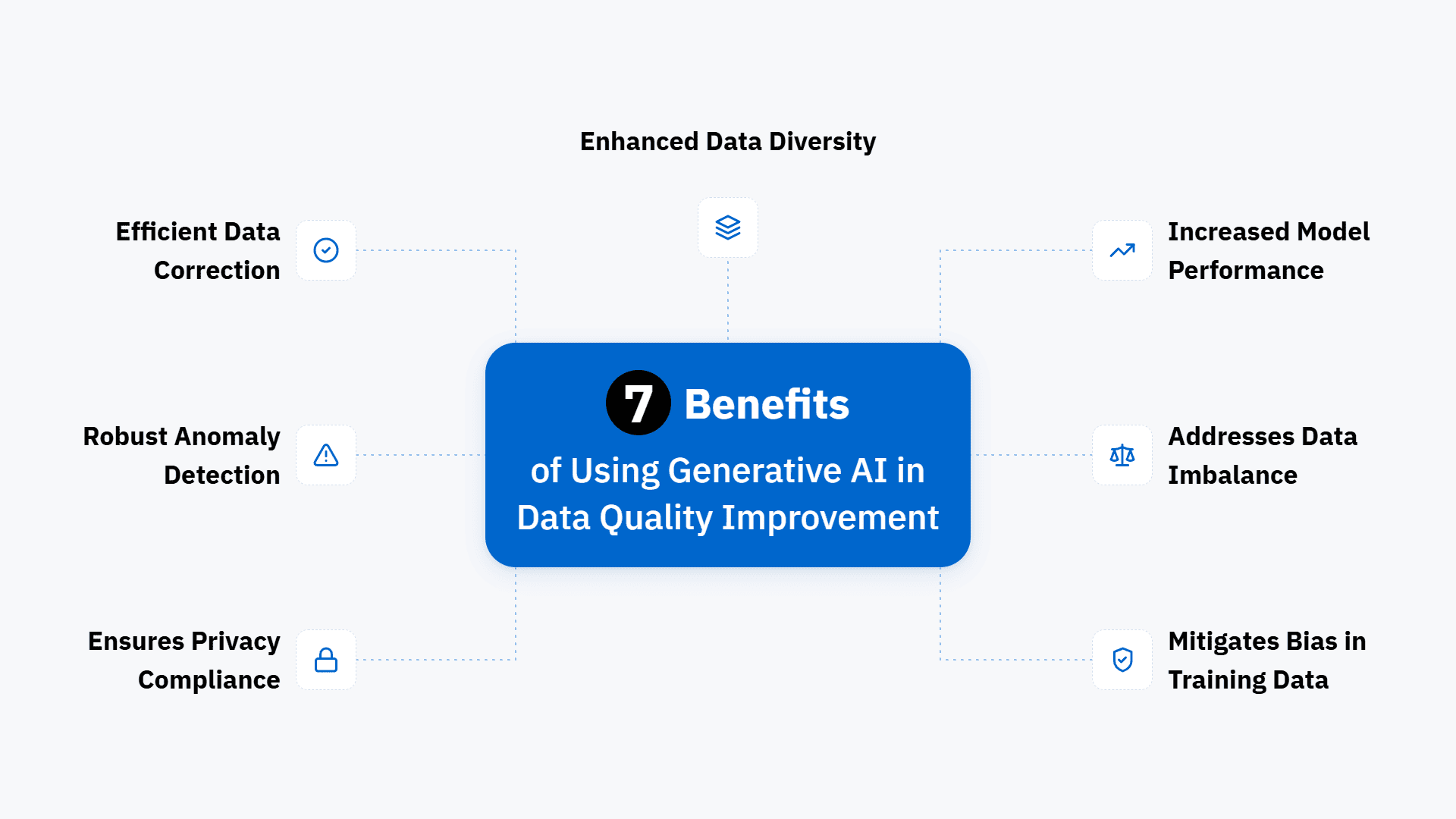
Data quality enhancement requires a lot of stats gathering, checking against established standards, finding patterns, and revealing anomalies – tasks where AI can significantly reduce manual effort. No wonder data engineers increasingly use generative and machine learning models for the tedious and time-consuming job of identifying issues such as typos, duplicates, missing values, and anomalies. AI can help suggest data quality rules, detect inconsistencies, and support the automation of machine learning data quality processes. By imputing missing values based on context and distribution, spotting potential outliers, and identifying inconsistencies, AI and ML techniques can help improve the quality of data used by downstream models. They can also assist in suggesting or refining data quality rules as data needs and sources change.
Nowadays, AI is widely used for data quality management, regardless of whether the datasets are built for ML training or business intelligence projects. Namely, AI-powered data quality automation can be employed for:
- Data creation and acquisition. Smart algorithms automate data extraction, enrich datasets with relevant information from other sources, and fix empty fields based on existing values.
- Data unification and maintenance. ML removes duplicate records, corrects typos, errors, and anomalies, and matches data with existing datasets.
- Data discovery and use. By spotting data correlations and finding relevant information, the models generate more insights along with new rules for data quality enhancement.
- Data protection and retirement. AI helps to ensure regulatory compliance by identifying sensitive information and detecting possible fraudulent behavior.
The real value comes from combining AI-assisted detection and recommendations with explicit quality rules, governance, and human oversight, creating a continuous feedback loop for improving enterprise data.
Can AI Be Trusted to Manage Data Quality?
Despite all the benefits of data quality automation with AI models, we need to keep in mind that they are just algorithms that may fail to understand the context required for accurate data cleansing. Moreover, datasets used to train them may be flawed, limiting the models’ capability to come to a correct resolution. So, it is crucial to use expert rules or human judgment in the process to help AI cope with complex scenarios. Having extensive experience and deep expertise in building reliable data platforms for AI deployment, IBA Group is ready to provide you with further recommendations and professional assistance on data quality enhancement — don’t hesitate to get in touch with our data engineers!
YOU MAY ALSO BE INTERESTED IN
- What Makes a Difference in Effective AI Adoption? Nothing Other Than Data Quality. Part 1.
- Databricks vs Snowflake: Is There Really a Winner?
- On the Way to Lakehouse
- Cloud vs On-premises: What is Better for Business?
- Why Migrating to the Cloud Brings Value
- Data Migration to Cloud: What You Will Get in the End
- Why Migrating to the Cloud Brings Value
- ETL/ELT: What They Are, Why They Matter, and When to Use Standalone ETL/ELT Tools
- Data Literacy: The ABCs of Business Intelligence
- BI Tools Comparison: How to Decide Which Business Intelligence Tool is Right for You
- Unsuccessful examples of BI development. Part I
- Examples of Unsuccessful BI Development. Part II
- BI Implementation Plan
- IBA Group Tableau Special Courses
- Integrating Power BI into E-Commerce: How to Succeed in Rapidly Developing Markets
- Analytics vs. Reporting — Is There a Difference?
- Better Business Intelligence: Bringing Data-Driven Insights to Everyone with IBM Cognos Analytics 11
- Building a Data-Driven Organization: From Data to Decision
Looking for Data Quality Expertise?
Whether you’re preparing data for AI, improving data quality across your platforms, or building reliable data pipelines and governance processes, IBA Group is ready to help.